A Little World, Made Sharp - KNIFE

Updated: Sep 16
Knife Manufacturing Company was named as a joke. It is, by its founder Andy Eclov's own admission, a word that has no business sitting next to the phrase miniature skateboard — aggressive, out of place, slightly absurd. Eight years on, the joke has held. So has the brand.
Conceived in 2018 as a provocation, Knife was built to fill a hole its founder had spent years staring at: a fingerboard industry that sold craft where he wanted brand, hand-sanded sincerity where he wanted identity, the warmth of a craft fair where he wanted the cool remove of a skate company. He had grown up in the early 2000s picking skateboards by their graphics — Zero, in his case, with its skull logo and dark visual language — and watching those graphics become his friends' personalities. He could not find the fingerboard equivalent. So he made one.
What follows is a long conversation with the founder, Andy Eclov, conducted from Chicago. We talked about the name, the team, the hardcore scene that shaped his eye, the warehouse that has just opened, the European and Asian distribution about to launch, and the principle that has governed every decision since the beginning: not everything is for everyone.

(NY) What’s the story behind the brand’s name, and what message do you want to convey through your products?
(AE) The name Knife came about as a joke when this whole project was originally conceived around 2018. The original idea was going to be a much darker and more extreme approach to everything, basically taking every aspect of a fingerboard brand as far over the top as possible just to see what happens. I’m not sure why we settled on Knife Manufacturing Company, I don’t think I ever really expected to actually use it as a brand name. At the time I was just trying to come up with something ridiculous and off-putting. It’s an aggressive sounding word but in the context of miniature skateboards it’s kind of bizarre and out of place, which has more or less set the tone of the brand since.

(NY) What inspired you to start this brand, and how did your journey in fingerboarding influence its creation?
(AE) I found fingerboarding when I was a little kid, around 2006/2007. While my involvement and interest varied over the years I always kept tabs on the world and industry of fingerboarding, it’s a fascinating place. I noticed that most brands sort of positioned and presented themselves in a way where there was no barrier between the customer and the creator/brand itself, every interaction with a fingerboard company was this interpersonal transaction, like buying a hand made product from a craft fair, having virtually no resemblance to the skateboarding industry. I wasn’t really seeing a brand on the market that I was excited to buy from, and I wanted to have the experience that I’ve always had with skateboarding, which is less focused on craftsmanship, complex veneer layups, exotic woods etc, and entirely focused on the “Brand” and a customer’s relationship with it. It felt like a glaring hole in the industry to me. After all these years I’d never really seen a fingerboard company take things to the extreme as far as building a brand identity and developing the voice, and I wanted to see what would happen if somebody did.

(NY) Can you share a moment in your fingerboarding life that shaped your approach to running a brand?
(AE) This didn’t come from fingerboarding, but it’s one of the driving ideologies of the brand that I have in mind with every new product or development: not everything is for everyone. Knife started as a fun side project, I made it to have an outlet to make whatever art I want to at any given time. I love making stuff, I love designing and photographing, editing video, traveling, collaborating, etc and this brand gives me the outlet to do all of those things at once. I have a very specific taste in aesthetics, music, etc and this brand is basically designed to reflect that. I’ve stuck to that since the beginning and I think it attracts a specific type of person, which is in-part how I ended up with an amazing team of riders who are also some of my best friends in the world. It goes back to what I was saying about not finding a fingerboard brand I wanted to buy from - there wasn’t anything out there to align myself with.
I grew up skateboarding in the early and mid 00’s. Basically everyone I knew picked a skateboard brand with the graphics they liked best, and then that brand sort of became their personality. I latched onto Zero instantly; skull logo, dark visual identity, cool guys with long hair jumping down giant stairsets - like it was made for 12 year-old me. My other friends attached themselves to other brands that better represented their personality at the time. That entire concept hasn’t really existed in the fingerboard space yet, but I feel like we’re on our way.

(NY) What were some of the biggest challenges you faced when launching the brand, and how did you push through them?
(AE) Launching was kind of the easy part, it just happened organically and slowly. The biggest challenge for the entire life of the brand has been board production. While the deck is obviously the core product, I’ve never had a burning passion for deck-making the way some people do. For me, Knife is more about the entire brand and our little world. The deck is one part of that puzzle. I want to spend my time filming, working on graphics, taking trips with the team, and developing the brand constantly. I’ve taken a few different approaches to production, we’ve always tried to compartmentalize the process. For the last couple of years I had a handful of different people helping make boards in a few different locations in Chicago. This year I decided it was time to start from scratch and revise all of this. Like I said, this was never supposed to be a full-fledged company, I wasn’t really prepared to make this a full-time project. We’ve spent the entire year redeveloping our production process, focusing on efficiency and consistency. We just moved into a new warehouse space (our second move in 2026) that is much bigger and completely private. It will allow us to expand and do all the things we’ve been dying to make happen. It feels like it’s taken forever to get to this point - every detail of the deck production has been painstakingly considered and revised over and over to make the best product we can, as efficiently as possible - these aging hands can’t hand-sand tiny fingerboards all day like they used to.

(NY) Do you handle design, marketing, and production yourself, or do you work with a team? What’s your creative process like?
(AE) My role as “Creative Director” for both Knife and Index is how I spend most of my time and that’s exactly where I like to be. Almost all of the Knife artwork, graphic design, photo, video, etc is done by me. Like I said earlier, this whole brand exists essentially to be an outlet for exactly that. One of my favorite parts of all of this is collaborating on creative projects. There are aspects that I like to retain complete control over, but there are a lot of projects that involve others as well. The Knife team is pretty hands-on with helping to make decisions in general, and a few of the guys have contributed artwork (Nolan and Stolly). Andy Cole and I have a special way of communicating big ideas for video projects with music and visuals and I love working together on pieces. We are just starting to release some of the first graphics that were commissioned artworks instead of my own originals. I had always wanted to work with a painter to create a series of graphics and take the visuals in a slightly new direction but it wasn’t until early 2026 that I met somebody whose style was what I was after and who could understand this very strange and specific application. It’s been a really cool process to work with some new artists and learn to collaborate in a new way. In most cases the core artwork is commissioned and I’m still doing typesetting, layouts, coloring, etc. Very excited about some of the graphics we’re rolling out this season.

(NY) Beyond selling products, what impact do you hope your brand has on the fingerboarding community, both locally and beyond?
(AE) I’d love to see more high quality videos being produced, more crews and teams coming together with a shared vision. To a lot of fingerboarders, the hobby has always been a solo endeavor. I think the emergence of more physical stores and bigger and more frequent events is pushing the scene towards a more social experience, and I’d love to see that channeled into new groups of people making what they think is cool - putting new products into the world, making videos and art together, all of that kind of thing. The emphasis we put on our videos, team, and brand identity is all there because it’s what I want to see more of in the fingerboard space and I’d love to share that with more likeminded people who are cut from different cloth. It’s really fun to see the ‘professional’ side of this thing taken more seriously, and seeing how that seriousness is interpreted by different people.
(NY) Have you had any moments where you felt, “This is why I do this”? Maybe someone wearing your gear, a big milestone, or a community event?
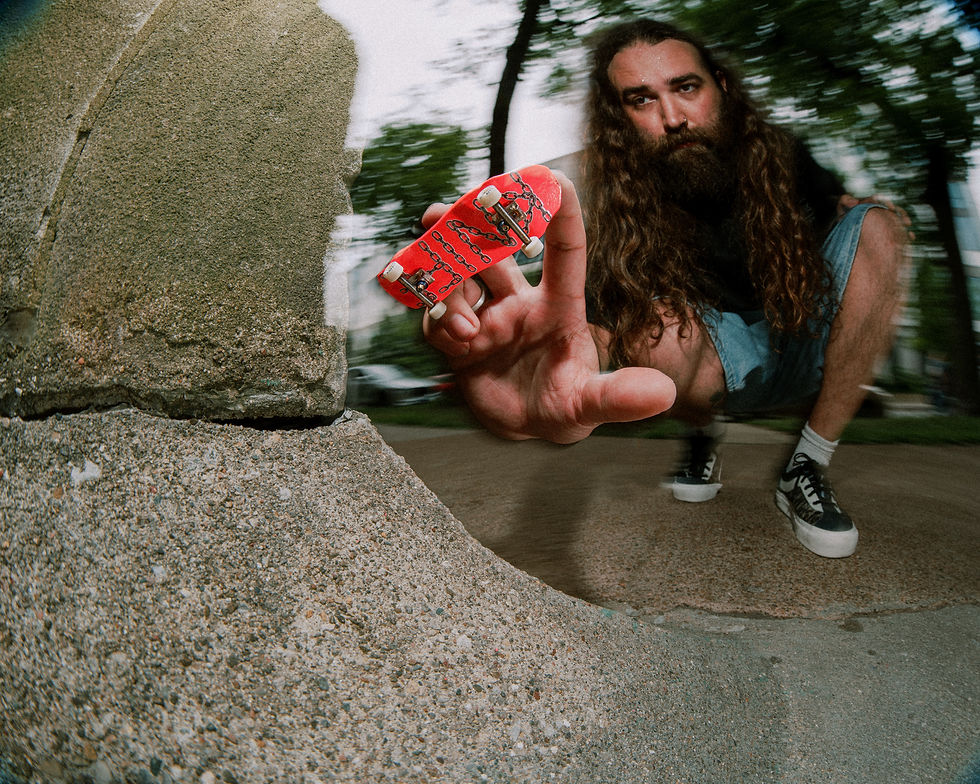
(AE) June 2024 was my first time attending Fast Fingers in Germany. I worked for Blackriver at the time and was there to photograph and film the event among other projects. I brought Brendan Houston with me, one of our pro riders and the first person to ride for Knife. I was absolutely overwhelmed by how many non-Americans came up to us so excited about Knife and to meet Brendan, ‘the guy from all the old videos’. I really had no concept of how far the brand had reached outside of my own circle of friends and world of fingerboarding in the US. It was kind of shocking to see how many people knew us on the other side of the world from so many different countries.
The thing that really gets me motivated is seeing people at events get stoked on our team riders. It is such a cool experience to see one of the guys get recognized for their video part and asked for an autograph or something.

(NY) Chicago has a deep skateboarding culture with a strong DIY ethos. How does the city’s skate/ fingerboard scene influence your brand’s identity and design choices?
(AE) Chicago skateboarding is kind of a weird beast. It was absolutely resistant to fingerboarding until very recently. Until now there’s been very little crossover between fingerboarding and skateboarding in Chicago. The DIY aspect plays a huge role though, I grew up in the Chicago hardcore music scene and everything was always about figuring out how to do it yourself. I owe basically everything to being introduced to underground punk music at a super young age. It came into my life at exactly the right time when I was figuring out art and music and everything and deserves all the credit for steering me in this direction. Although I’ve never really been plugged into the actual art scene in the city, alternative art from Chicago has always had a really specific edge to it that I can’t quite put my finger on, but it’s a sort of awkward mishmash that seems to come from the dilemma of not being NYC or LA. The Chicago music scene has always been a good representation of that.

(NY) How do you support the local Chicago fingerboard scene? Do you sponsor skaters, host events, or contribute to DIY skate spots?
(AE) I co-own a fingerboard store here in the city called Index with my friend Nash. Our shop is located in the heart of Wicker Park which is one of the main shopping and arts areas of Chicago, we’re neighbors with Supreme, Adidas, Carhartt, Uprise Skateshop, etc. The space is open to the public 4 days a week and is currently packed with about 8 full size fingerboard parks that are free to session any time. We regularly host events, contests, tournaments, video premieres, etc. We’re really picky about what we sell at the store and try to bring in brands and products that we really love and believe in. We’ve put an emphasis on carrying international products that are sometimes difficult to get in the US, as well as carrying smaller start-up brands from Chicago or the midwest. We have a really, really amazing scene here in Chicago. The store is full most days, and the community is incredibly good to each other - it’s a beautiful thing. We really put a lot of emphasis on our community and do our best to support our locals.
Knife has a team that’s spread out around the world and most of our team riders are also involved in various communities. Stolly, for example, organizes several amazing events in Germany every year with a group of people. We also try to contribute where we can to our non-fingerboarding Chicago community. This year we’ve organized a handful of raffle-type contests on our website to raise money for local animal shelters and things like that.
(NY) What’s next for the brand? Any upcoming projects, new product drops, or collaborations we should be excited about?
(AE) 2026 has been a pretty intense year so far with a lot of big plans ahead of us. We spent the entire winter and spring revising our board production entirely from scratch. We just moved into a new warehouse / headquarters space over the last couple of weeks, it’s a little scary - it’s a big commitment, but it’s been extremely exciting and motivating and will allow us to push the brand forward in ways I’ve been dreaming about since it’s inception.
We’ve started filming for another full-length team video that we are planning to release towards the end of the year. This month (May) we start a months-long “tour” made up of various filming trips and shop visits/collab events. In a few weeks we’ll jump in a van for our first trip out to Richmond, VA to visit Letter Store. In September a bunch of us will head to Portugal for Oak and Flint’s Pateo event and a few weeks of filming and traveling in Europe. Between now and then we’ll be criss-crossing the US/Canada visiting shops and cities working on this video project.
We have several collabs in the works, international distribution for European and Asian markets about to launch, and a ton of new products lined up - board graphics, shapes, merch, etc.
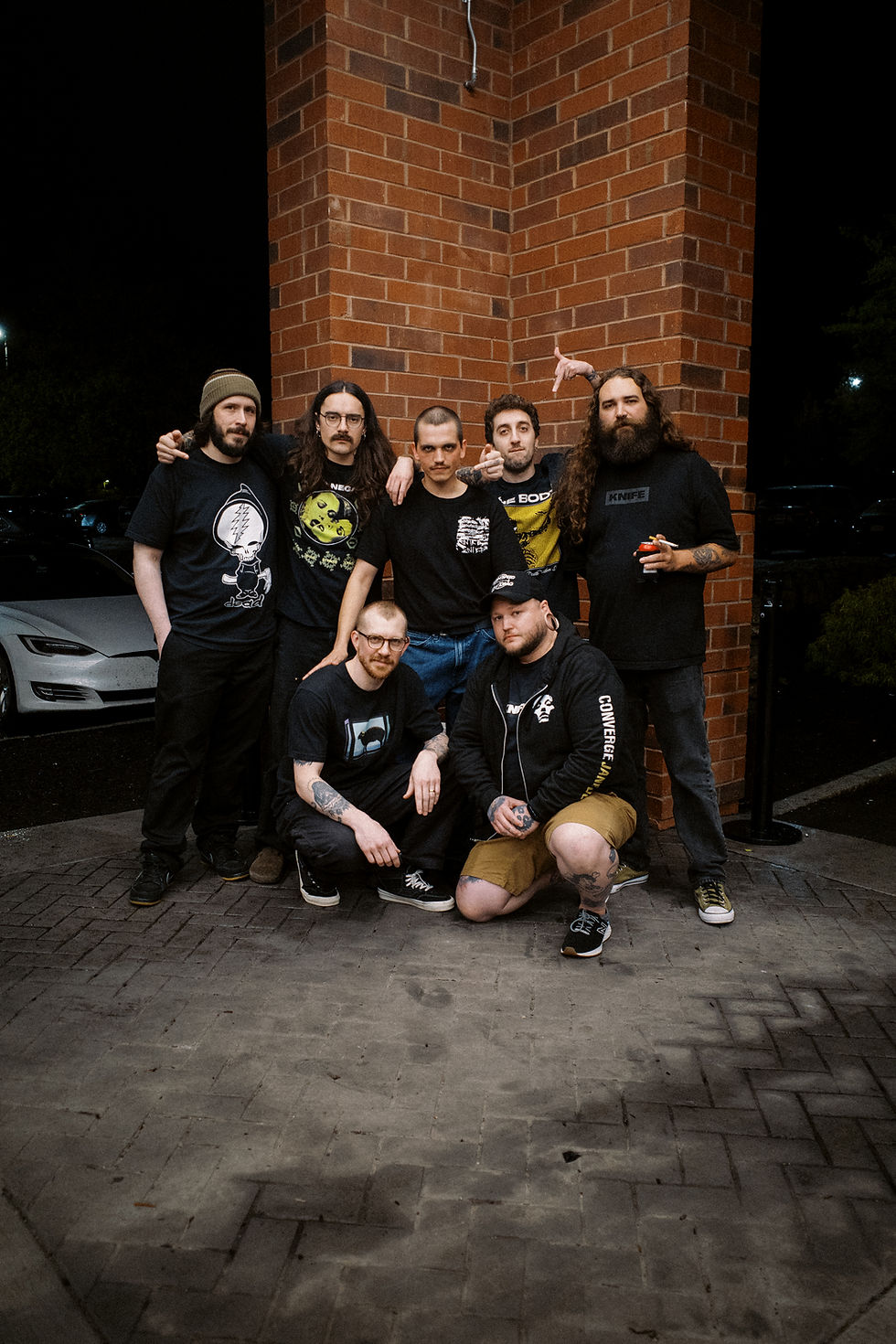
I am really excited for the rest of the year, we have a lot planned and we will all get to spend a lot of time together which is the greatest gift. I really can’t overstate how important and special it is to have this group of people who are all stoked and driven to make our little fingerboard project as good as it can be.
Andy Eclov
Instagram: @knifemfgco